My uncle still drives past his old fields outside Ames every Sunday after church.
He sold the last 80 acres two years ago to a buyer he never met. He got a good price. Now he has a check that has to last.
That is your read this afternoon. Plenty of family wealth in this generation sits in land, and a lot of that land is changing hands.
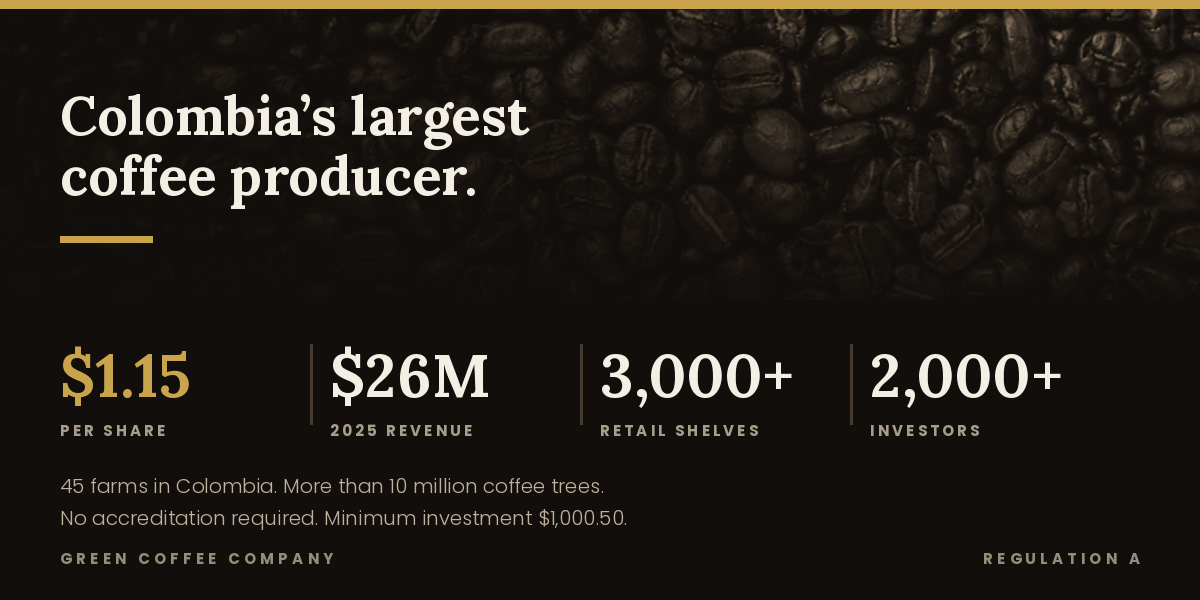
Land that grows a crop is about the oldest investment there is. One coffee company built its whole case around exactly that.
Back home, the Agriculture Department priced American farmland again this summer. The average farm, land and buildings together, reached $4,500 an acre.
That is up 3.4% in a year. Since 2020, nearly 44%. Cropland alone passed $6,000 an acre for the first time.
The same farm looks very different depending on which side of the ledger you stand on.
What they own: a record on paper
Cropland averaged $6,020 an acre in 2026. The cash rent it brings in averaged $160 an acre, a dollar less than last year.
Who works it: the 65-and-older
In the last farm census, 38% of America’s 3.4 million producers were 65 or older. Their number grew 12% in five years while the 35-to-64 group shrank 9%.
Put those side by side and the asymmetry shows. The price climbs. The rent sits still.
At $160 on $6,020, an acre returns about 2.7% of its value in rent. The owner is richer on paper every year and no richer at the kitchen table.
That gap is why so many older owners eventually sell. Paper value turns into spending money only at the closing.
Where the cohort’s money sits this quarter, and where the family land fits in each aisle.
The honest limit is that land does not only go up. Farmland crashed in the 1980s, and the yearly gains have slowed every year since 2022.
Higher interest rates weigh on it too. The Fed raised rates in September. Land buyers borrow.
Land is one of the two oldest ways to hold wealth outside a bank. Gold is the other, and it has a Washington story of its own.
The arithmetic
USDA National Agricultural Statistics Service, Land Values 2026 Summary (August 2026): farm real estate $4,500 per acre, up 3.4%; cropland $6,020 per acre, up 3.3%, the first average above $6,000; cropland cash rent $160 per acre, down $1 from 2025. Farm real estate up nearly 44% since 2020: American Farm Bureau Federation analysis of the same report. USDA NASS, 2022 Census of Agriculture, Farm Producers highlights: 3.4 million producers; 38% aged 65 or older; producers 65 and older up 12% (1.15 million to 1.29 million) and producers 35 to 64 down 9% from 2017 to 2022. Rent as a share of value, Boomers Trade’s own arithmetic: 160 / 6,020 = 0.027, about 2.7%. Federal Reserve rate increase of September 16, 2026. Farmland price collapse during the farm crisis of the 1980s: USDA land value history. The uncle outside Ames and his 80 acres are an illustration.
Next August the Agriculture Department prices the land again. When it does, read the rent line first. If rent keeps lagging the price, more of this generation’s acres will come up for sale, one estate at a time.
Andrew
Boomers Trade is written by someone getting older right alongside you, and watching who profits from it.
|