Ask anyone my age who winters in Medellin what changed this year. The weather has not changed, and the menu prices have barely moved. The dollar is a different story.
Through mid-October, the dollar lost 15.6% against the Colombian peso. That is a big move for one year. The peso has been the best-performing emerging-market currency of 2026.
Take an apartment that rents for one million pesos a month. In January, that cost an American about $266. At mid-October rates, it costs about $315.
Same keys, same view, same landlord. It just costs about 18% more in dollars than it did on New Year’s Day.
And plenty of us pay it. Americans made up 24% of the 5.1 million foreign visitors to Colombia last year, the largest single group. In Medellin, one foreign visitor in three came from the US.
Most of us grew up assuming the dollar travels well. That habit dates to the 1970s, when oil started being priced in dollars and the whole world needed them.
Some analysts think that era is ending. Porter Stansberry, a longtime financial publisher, is one of them. He argues the dollar itself is being reset, and he lays out what he would own.
Where the cohort’s money sits this quarter, and where a weaker dollar bites first.
Why did the peso climb so far? Colombia’s central bank holds its key rate at 12.25%. Money from abroad chases that yield, because few large economies pay as much. Buying pesos to earn it lifts the currency. Visitors pay the difference.
Prices inside Colombia kept moving at the same time. Consumer prices there rose 6.29% in the year to September.
For a visitor paying in dollars, the two effects stack on top of each other. The currency move alone shows up on the monthly rent.
$315
Monthly cost in dollars of a one-million-peso rent, mid-October 2026
$266
The same rent at the start of 2026
Same apartment, same peso price. The whole gap is the exchange rate, before local inflation adds its own share.
So who comes out ahead when the peso climbs?
Whoever owns real things in Colombia and keeps score in dollars. A farm, a building or a working business there is priced in pesos. When the peso rises, each one is worth more to a dollar holder. Nothing about the asset has to change.
The catch is that currencies swing both ways. The peso fell hard in 2022. It could fall again. Anyone planning a winter abroad should budget in pesos and expect the dollar figure to move.
One thing has not moved. Colombia’s signature crop still grows on hillsides like the ones outside Medellin.
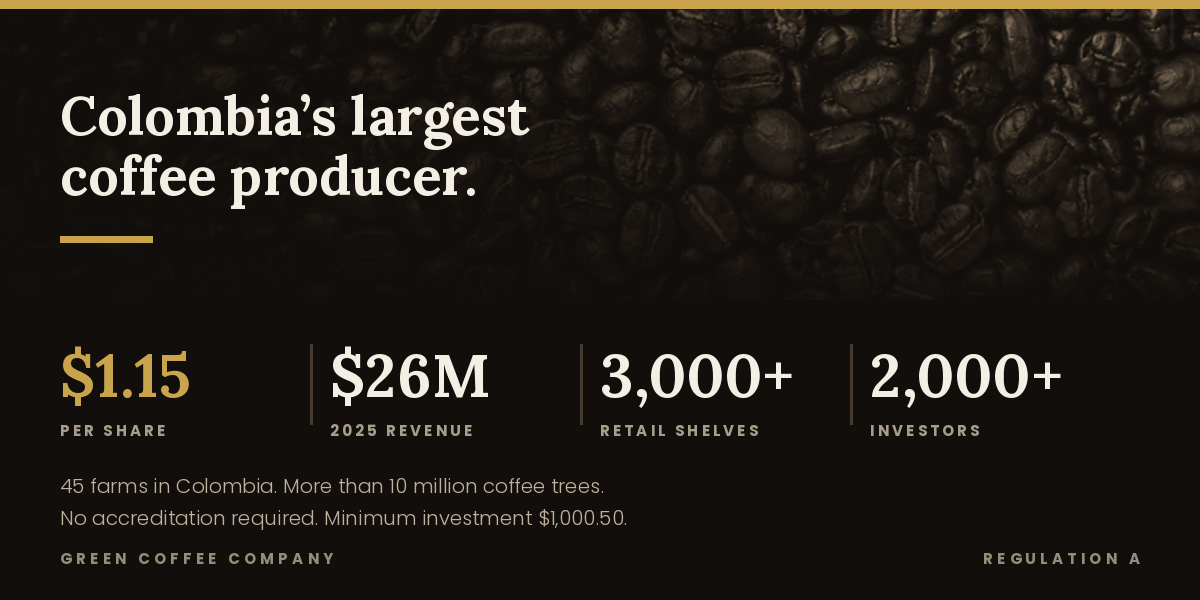
One company owns and operates 45 coffee farms there. It is still private, and individual investors can buy in.
The arithmetic
Dollar down 15.61% against the Colombian peso in 2026 and the official TRM rate of 3,170.46 pesos per dollar on October 16, 2026: Global66 and Portafolio, October 16, 2026; the peso as the year’s best-performing emerging-market currency: Global66, quoted by Portafolio. Rent arithmetic is Boomers Trade’s own: a start-of-year rate implied by that 15.61% move, about 3,757, gives 1,000,000 / 3,757 = $266; 1,000,000 / 3,170.46 = $315; 315 / 266 = 1.18. Banco de la Republica policy rate of 12.25%: Portafolio market data, October 6, 2026. Colombian consumer prices up 6.29% in the year to September 2026: DANE, via Portafolio. 5.1 million foreign visitors to Colombia in 2025, 24% from the United States: ANATO, via Semana, January 2026. Medellin, 1.2 million foreign visitors in 2025, a third from the US: Medellin tourism office, via Travel Agent Central. Peso weakness in 2022: historical exchange-rate data. Green Coffee Company figures, including its 45 farms: company offering materials. A rate of 3,500 gives 1,000,000 / 3,500 = $286, under $290; 3,000 gives $333, past $330.
Before booking a winter there, watch one number: the TRM, Colombia’s official daily dollar rate. Above 3,500, that one-million-peso rent drops back under $290. Below 3,000, it climbs past $330. Price the trip in pesos first. The dollars will tell you the rest.
Andrew
Boomers Trade is written by someone getting older right alongside you, and watching who profits from it.
|